

The Architect's Dilemma: A Clean Ceiling vs. Code Compliance
Picture this: a high-end commercial fit-out in Auckland's Viaduct. The design calls for a seamless, monolithic ceiling plane. Then, the fire protection engineer arrives, and the plans are suddenly dotted with sprinkler heads. It’s a classic tension in building design—the push for clean aesthetics versus the non-negotiable requirements of fire safety. For years, the solution was a compromise. But what if it doesn't have to be?
Modern concealed sprinklers offer a powerful resolution to this conflict, providing robust, compliant fire protection that remains almost invisible until the moment it's needed. They allow architects to achieve their design intent without pushing back on life safety systems mandated by the New Zealand Building Code (NZBC).
How a Concealed Sprinkler Works
Unlike traditional pendent or upright sprinklers where the entire head is visible, a concealed sprinkler is a two-part assembly. The sprinkler itself—containing the thermal element and deflector—is housed in a cup recessed into the ceiling void. All that's visible from below is a flat, low-profile cover plate, often no larger than a smoke detector.
This cover plate is attached to the sprinkler body with a temperature-sensitive solder. In a fire, the solder melts at a lower temperature than the sprinkler's activation point. The plate falls away, allowing the deflector to drop down into the airstream. As the ceiling temperature continues to rise, the sprinkler's glass bulb bursts, releasing water in a precisely engineered spray pattern. It's a two-stage activation that ensures the system is both aesthetically pleasing and fully effective.
Product Spotlight: The Tyco Series RFII-C (5.8K)
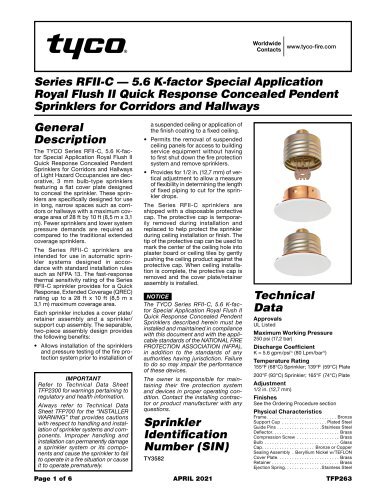
A prime example of this technology is the Tyco Series RFII-C Concealed Pendent Sprinkler. This isn't just a standard head with a cover; it's engineered for performance in the spaces where looks matter most.
- K-Factor: With a K-Factor of 83.6 (5.8K in US units), it's designed for light hazard occupancies—think office buildings, hotels, and apartment complexes—as outlined in NZS 4541.
- Response Time: It's a 'quick response' sprinkler, meaning it activates faster than standard response heads, which is crucial for controlling a fire in its early stages and improving occupant survivability.
- Installation & Finish: The design features a separable two-piece mounting cup. This is a smart detail that allows the pipework and sprinkler cup to be installed and pressure tested *before* the ceiling is installed and painted. The cover plate can be pushed on as a final finishing step, with up to 1/2 inch (12.7 mm) of adjustment to ensure a perfect flush fit. Cover plates are available in a standard white finish but can also be custom painted to match any ceiling colour.
The NZS 4541 Context: Where Do They Fit?
In New Zealand, concealed sprinklers are an excellent choice for buildings falling under NZS 4541 for Light Hazard occupancies. Their use in apartment buildings, which often follow a modified 13R-type system, is particularly common. Architects and developers favour them for achieving a high-end, residential feel without the industrial look of exposed sprinklers.
However, installation precision is critical. The cover plate must be fitted correctly, with no gaps and without being caulked or painted over, as this could impede its ability to drop away during a fire. It is the designer's responsibility to specify the correct product and the installer's duty to ensure it's fitted precisely to the manufacturer's data sheet and the standards, maintaining both the aesthetic and the life-saving function.
Ultimately, products like the Tyco RFII-C prove that fire safety and architectural vision can coexist beautifully. They are a testament to the fact that the most effective life safety systems are the ones you never have to see.